

In contrast to destructive methods, non-destructive testing (NDT) techniques allow for the evaluation of concrete’s compressive strength and overall quality without causing permanent damage to the structure. These methods are invaluable for assessing existing structures, monitoring curing, and quickly identifying potential issues without compromising the concrete’s integrity.
What is Non-Destructive Testing?
Non-destructive testing methods for concrete compressive strength rely on measuring indirect properties of the concrete, which are then correlated to its strength. The goal is to gain information about the concrete’s condition and properties without breaking or altering it.
Common non-destructive methods include:
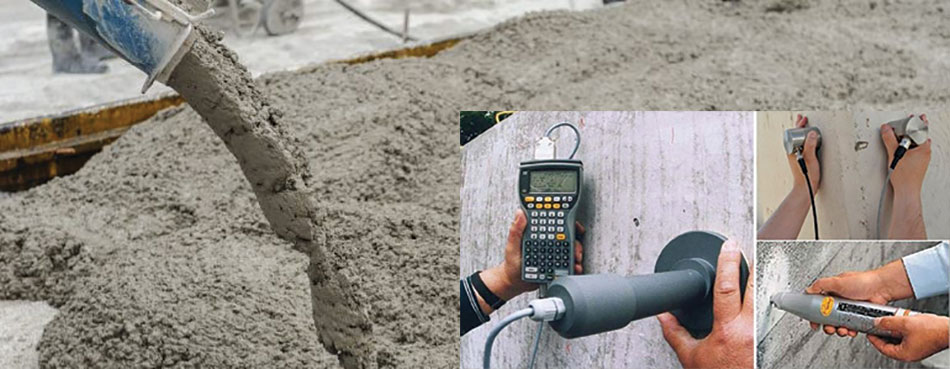
Rebound Hammer Test (Schmidt Hammer Test): This widely used method involves impacting the concrete surface with a spring-loaded hammer and measuring the rebound distance. A higher rebound number generally indicates higher concrete strength.
Ultrasonic Pulse Velocity (UPV) Test: This method measures the speed of ultrasonic pulses through the concrete. The pulse velocity is influenced by the concrete’s density, homogeneity, and elastic properties, which can be correlated to its compressive strength.
Maturity Method: This method involves embedding temperature sensors in fresh concrete to monitor its temperature history. By using a pre-established maturity function, the equivalent concrete strength can be predicted based on the cumulative temperature and time.
Penetration Resistance Test (Windsor Probe Test): A powder-actuated device drives a hardened steel probe into the concrete, and the depth of penetration is correlated to the concrete’s strength. While it leaves small indentations, it’s generally considered non-destructive in the context of structural integrity.
Advantages of Non-Destructive Testing:
No Damage to Structure: The primary advantage is that NDT methods do not damage or destroy the concrete, making them ideal for evaluating existing, in-service structures.
Rapid Assessment and On-Site Use: Many NDT methods provide immediate results and can be performed quickly on-site, allowing for rapid assessment and decision-making during construction or inspection.
Cost-Effective (Per Test): While initial equipment costs can vary, the cost per test is generally lower than destructive methods, as there’s no material waste or extensive sample preparation.
Full Coverage and Uniformity Assessment: NDT allows for widespread testing across a large area, helping to identify variations in concrete quality, potential weak zones, or areas of deterioration within a structure.
Monitoring Over Time: NDT methods can be used repeatedly on the same structure to monitor changes in concrete properties over its lifespan, track curing progress, or assess the effectiveness of repairs.
Accessibility: Many NDT devices are portable and can be used in challenging or difficult-to-access locations.
Disadvantages of Non-Destructive Testing:
Indirect Measurement: NDT methods provide an indirect estimation of compressive strength. The results are influenced by various factors (e.g., aggregate type, moisture content, surface condition, presence of rebar), and correlations with actual compressive strength often need to be established through destructive tests on similar concrete mixes.
Lower Accuracy (Compared to DT): While useful for comparative analysis and identifying general trends, NDT results are typically less precise and accurate than direct destructive tests.
Influence of Surface Conditions: Surface hardness tests like the rebound hammer can be significantly affected by the concrete’s surface finish, carbonation, or moisture content.
Operator Skill : Accurate results often depend on the skill and experience of the operator, as well as proper calibration of the equipment.
Limited Depth of Penetration: Some NDT methods, especially surface-based ones, may only provide information about the near-surface concrete, potentially missing deeper flaws or variations.
Correlation Required for Absolute Strength: For a reliable estimation of absolute compressive strength using NDT, it is almost always necessary to correlate NDT readings with destructive test results from cores or cast specimens of the same concrete.
In summary, non-destructive testing offers a powerful and versatile toolkit for assessing concrete quality and providing valuable insights without damaging the structure. While they are often less accurate than destructive tests for determining absolute strength, their ability to provide rapid, widespread, and non-intrusive assessments makes them an indispensable part of modern concrete evaluation and quality assurance practices.
